Montessori Preschool Curriculum: What Your Child Actually Does All Day
Posted on August 26, 2026
Written by the lead teacher at Montesshare, an AMS certified Montessori educator serving Alexandria, VA families since 2017.
You tour a Montessori classroom and see a three year old pouring dried beans from one small pitcher into another. She does it eleven times. Nobody stops her, and nobody praises her either.
If your first thought is “that is not school,” you are asking exactly the right question. Most parents think it and almost nobody says it out loud.
So here is the honest answer. This is what a Montessori preschool curriculum does with your child’s six hours, why the beans matter more than a worksheet at this age, and what to watch for when you visit a classroom yourself.
The First Hour, and Why Nobody Rings a Bell
Your child arrives, hangs up her own coat, changes her own shoes, and chooses her first activity. That is it. There is no circle time announcement, no worksheet handed out, no whole group lesson to sit through.
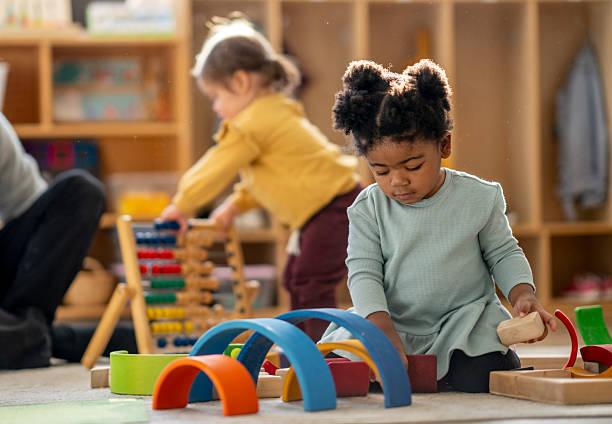
This feels chaotic for about four minutes, until you notice that every child is doing something on purpose. One is washing a small table. Two are counting rods together. One is tracing sandpaper letters with a finger. A teacher is kneeling beside a child, showing him something slowly, without talking much.
What you are watching is called the work cycle, and it is the spine of the whole day. Children choose their work, complete it, and return it before starting something else. The teacher introduces new material to one child at a time, then steps back.
The reason nobody rings a bell is that interruption is the enemy here. A child who is finally concentrating hard on something is doing the most valuable thing she will do all morning, and pulling her out of it to join a group activity costs more than the group activity gains.
Where Reading and Numbers Come In
They do, and earlier than most parents expect. Montessori just gets there by hand first.
Language. Children hear real vocabulary all day, then meet letters as sounds rather than names. Sandpaper letters are traced with a finger while the sound is spoken, so the hand and the ear learn together. The moveable alphabet lets a child build a word out of loose letters before she can physically write one, which means she can spell months before her hand is ready to form letters.
Mathematics. Number rods, counters, and beads make a quantity something a child can hold. Ten is a weight in her hand before it is a symbol on paper. She matches quantity to numeral, then builds larger numbers, then discovers that four groups of two is the same as eight. The abstraction arrives after the physical experience, not instead of it.
Sensorial work sits underneath both. Sorting cylinders by width, matching fabric textures with eyes closed, arranging bells by pitch. Your child is training the ability to notice small differences and sort information, which is what reading and arithmetic both demand later.
What the Teacher Is Doing While Your Child Works Alone
Not standing at the front. Mostly watching, and writing things down.
A Montessori teacher’s main job is observation. She is tracking what your child chose, how long she stayed with it, what she avoided, and what she is nearly ready for. When a child masters one activity, the teacher offers the next step, individually, at the moment it is useful.
That is why the low ratio matters more here than in a teacher led classroom. Individual observation only works if there are few enough children to actually observe. At Montesshare our group is 12 children with 2 to 3 teachers, which is what makes the model function rather than just look nice on a website.
If you are comparing a Montessori children program for a one or two year old, the same principle applies with more physical support. children need help with the task and get it, but the adult never finishes the job for them.
Mixed Ages, and Why Your Child Benefits Either Way
Montessori classrooms group children across roughly three years rather than sorting them by birthday.
If your child is younger, she watches an older child do something difficult and understands it is possible. If she is older, she teaches, which is the point at which she truly owns a skill. Explaining how the number rods work to a younger child is harder and more valuable than doing it silently.
This is also where the social side is built. Children negotiate for a material there is only one of, wait for a turn, work at the same table without merging, and resolve small disputes with a teacher nearby rather than intervening instantly. Those are the exact behaviors kindergarten teachers watch for in the first weeks of school.
What to Look for on a Tour
Visit during a working morning, never after hours. Then watch for these seven things.
Is the room calm without being silent? A working Montessori room has a low busy hum. Total silence and loud chaos are both warning signs.
Can children reach everything? Materials on low open shelves, in a logical order, with everything in its place. If a teacher has to fetch things, the environment is not doing its job.
Are the materials real? Glass pitchers, ceramic bowls, metal utensils, wooden puzzles. Plastic everything usually means the practical life work is decorative rather than genuine.
Does anyone finish anything? Watch one child from start to cleanup. If nobody completes a full cycle, the schedule is too fragmented.
How does a teacher handle a spill? You want to see a cloth handed over, not an adult cleaning it up.
How does a teacher handle a conflict? Look for the pause before intervening, and language given to children rather than a verdict handed down.
What is on the walls? A room papered with commercial alphabet posters and graded worksheets is usually not running a Montessori curriculum, whatever the sign outside says.
Questions Worth Asking
Bring these with you. Vague answers tell you as much as specific ones.
- Walk me through 9 to 11 a.m., minute by minute.
- How many children per teacher, right now, not on paper?
- What training does the lead teacher hold?
- How long is the uninterrupted work cycle?
- What happens when my child finishes something early and is bored?
- How will you tell me if she is struggling with something?
- What practical life activities are available this month?
- If Spanish or another language is offered, is it a weekly lesson or part of the day?
That last one matters. At Montesshare, Spanish runs through the daily work cycle year round rather than appearing as a separate class, so children hear it in ordinary instructions and conversation. You can see more about our program .
Choosing a Program That Fits Your Child
There is no single best Montessori preschool for every family, and any school claiming otherwise is selling rather than teaching.
What separates a strong program from a weak one:
- A lead teacher with genuine Montessori credentials, not just a school that uses the name
- A ratio low enough for real observation
- Authentic materials in good condition and in complete sets
- An uninterrupted work cycle protected from constant transitions
- Honest, specific communication about your child’s progress
- Practical life work treated as core curriculum rather than decoration
Ask about licensing and accreditation too. Montesshare operates as a state licensed, NAFCC accredited home based program led by an AMS certified teacher, and you can read about our background.
Frequently Asked Questions
What is included in a Montessori preschool curriculum?
Practical life, sensorial work, language, mathematics, and cultural studies, with social development and fine motor work woven through all of them rather than taught separately. Children move between these areas by choice during an uninterrupted work period.
Why does my child spend so long on one small activity?
Because she chose repetition, and repetition is how concentration is built at this age. A child who repeats an activity eleven times is not stuck. She is practicing until she owns it, which is the habit that makes later academic work easier.
How is Montessori different from a traditional preschool?
A traditional preschool usually moves the whole group through a schedule of teacher led activities. A Montessori classroom gives children a long work period, individual lessons, hands on materials, and choice within clear limits, with the teacher observing and guiding rather than directing.
At what age can my child start?
Most Montessori programs group children in stages instead of by birthday. The youngest children get more hands on adult support, and primary classrooms typically serve ages three to six. Ask which age ranges a school actually serves, and how it handles the move between stages, since that transition is where some programs are stronger than others. You can check our current age groups listing.
How do I know if a school is authentically Montessori?
Look at the lead teacher’s training, the completeness of the materials, whether children can access everything independently, and whether the work cycle is genuinely uninterrupted. The word Montessori is not trademarked, so the classroom tells you more than the name.
Will Montessori prepare my child for a traditional kindergarten?
It prepares the parts that matter most: independence, concentration, the ability to finish a task, and the social skills teachers assess in the first weeks. Ask any program how it handles the transition and what previous families experienced.
What This Adds Up To
A Montessori preschool curriculum looks unhurried from the doorway and relentless up close. Nobody is being pushed through a syllabus, and yet a four year old who has spent a year in a good classroom can pour, sweep, dress herself, spell a word with loose letters, hold quantity in her hands, wait her turn, and stay with something hard for twenty minutes.
Those are not preschool skills. They are the ones everything else gets built on.
If you want to see what that looks like in a small, licensed home setting in Alexandria, VA with an AMS certified Montessori teacher, Spanish woven through the day, and 12 children supported by 2 to 3 teachers, come watch a working morning. You will learn more in twenty minutes of observation than from any website, including ours.
Take a virtual tour and start your admissions journey with Montesshare
Or call 202-320-0747, and we will get back to you. Bring your list of questions. We like the hard ones.
More ideas for supporting this work at home are in our resources for parents.
Frequently Asked Questions