Montessori Preschool Near Me: What Parents Should Look For in Early Childhood Education
You’ve searched for a Montessori preschool near me because you desire what every parent innately desires:to give your child the best possible start.
The preschool years are some of the most important years of a child’s life. During this time children build confidence, independence, social skills and a lifelong love of learning. Choosing the right preschool isn’t just about finding childcare. It’s about finding an environment where your child can thrive.
This is why Montessori education is growing in popularity across the United States, as well as internationally. Families are drawn to the Montessori approach because it respects each child’s natural curiosity while helping children develop academic, social and practical life skills.
In this guide you’ll learn what makes Montessori unique, how the Montessori preschool curriculum works and what to look for when evaluating a preschool in Alexandria VA that families cantrust.
What Is Montessori Education?
Montessori education was developed by Italian physician and educator Maria Montessori,who opened her first school in 1907.
Her educational philosophy was based on a simple but powerful idea: children are naturally eager to learn when given the right environment and opportunities.
The Montessori method emphasizes:
- Respect for the child
- Independence
- Self-directed learning
- Hands-on exploration
- Intrinsic motivation
- Real-world experiences
Rather than relying on rewards or constant direction from adults, Montessori education encourages children to develop a love of learning from within.
Today Montessori schools around the world continue to follow these principles and prepare children for academic and personal success.
How Montessori Builds Independence From an Early Age
One of the main reasons families search for a Montessori preschool near me is that this style of education empowers children towards independence.
Montessori education is based on the idea that children are capable individuals who learn best when given the opportunity to do things for themselves.
In a Montessori classroom children are encouraged to:
- Choose activities independently
- Care for classroom materials
- Complete tasks without constant adult intervention
- Take responsibility for their environment
- Develop confidence through daily success
Rather than rushing to solve every problem, Montessori teachers guide children towards finding the solution themselves.
This helps children develop:
- Self confidence
- Problem solving skills
- Responsibility
- Decision making abilities
- A sense of accomplishment
These benefits often extend beyond preschool and into elementary school, adolescence and adulthood.
Why More Families Search for a Montessori Preschool Near Me
Parents today have more educational options than ever.
Many families choose Montessori because it focuses on the whole child, not just academic performance.
An excellent Montessori preschool supports:
- Cognitive development
- Emotional growth
- Social skills
- Physical coordination
- Independence
- Responsibility
Research shows that children in Montessori programs often demonstrate strong problem solving skills, confidence and self motivation.
For many parents these qualities are just as important as early reading and math skills.
What Makes a Montessori Classroom Different?
One of the first things parents notice when visiting a Montessori classroom is how different it feels.
The environment is calm, organized and intentionally designed for children.
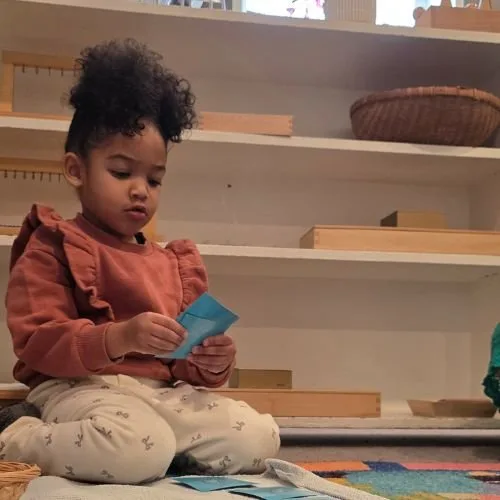
Prepared Environment
The Montessori classroom is known as a prepared environment.
Everything is carefully arranged to help children learn independently.
You’ll often notice:
- Child-sized furniture
- Open shelves
- Organized learning materials
- Clean and inviting spaces
- Freedom of movement
Children are encouraged to choose activities, move around the classroom and explore at their own pace.
Mixed-Age Learning
Unlike traditional classrooms, Montessori classrooms typically have a three year age span.
This allows:
- Younger children to learn from older peers
- Older children to develop leadership skills
- More collaboration
- Stronger social development
Mixed age learning creates a supportive classroom community where children naturally help and inspire each other.
Teachers as Guides
In Montessori education teachers are guides not traditional instructors.
Their role is to:
- Observe each child
- Introduce new lessons
- Provide encouragement
- Support individual growth
This allows children to develop confidence while taking ownership of their learning.
Understanding the Montessori Preschool Curriculum
The Montessori preschool curriculum is designed to support holistic development.
Rather than separating learning into rigid subjects Montessori connects different areas of development in meaningful ways.
Core curriculum areas include:
Practical Life
Practical Life activities help children develop independence and responsibility.
Examples include:
- Pouring water
- Folding cloths
- Preparing snacks
- Sweeping
- Buttoning clothing
- Caring for plants
These lessons may seem simple but help children build concentration, coordination, confidence and self reliance.
Sensorial Learning
Sensorial materials help children refine their senses and better understand the world around them.
Children explore concepts such as:
- Size
- Shape
- Color
- Texture
- Sound
- Weight
Language Development
Montessori language materials help children develop:
- Vocabulary
- Letter recognition
- Phonics
- Writing skills
- Reading readiness
Because learning is hands-on, children often develop strong language foundations naturally.
Mathematics
Montessori math materials allow children to physically interact with mathematical concepts.
Children learn:
- Counting
- Number recognition
- Addition
- Subtraction
- Place value
- Problem solving
Abstract concepts become easier to understand through concrete experiences.
Cultural Studies
Children explore:
- Geography
- Science
- Nature
- History
- Different cultures
This encourages curiosity and a broader understanding of the world.
Why Montessori Practical Life Activities Matter
Among all areas of the Montessori curriculum, Montessori Practical Life activities are often the most misunderstood by parents.
At first glance, activities such as washing tables or pouring water may appear simple.
In reality, these lessons are building essential life skills.
Practical Life activities help children develop:
- Independence
- Concentration
- Responsibility
- Coordination
- Confidence
- Order
These activities also teach children how to care for themselves, others, and their environment.
Many educators believe that Practical Life forms the foundation for future academic learning because it helps children develop focus and self discipline.
The Benefits of Long Uninterrupted Work Periods
One distinctive feature of Montessori education is the use of long work periods.
Rather than constantly transitioning between activities, children are given uninterrupted time to explore, practice, and master skills.
This supports:
- Deep concentration
- Problem solving
- Persistence
- Independent thinking
When children have the freedom to stay engaged with meaningful work, they often develop stronger learning habits.
Language Exposure and Cognitive Development
Many Montessori programs introduce children to additional languages at an early age.
Some Montessori schools provide daily exposure to languages such as Spanish and French.
Research suggests that early language exposure can support:
- Cognitive flexibility
- Memory development
- Communication skills
- Cultural awareness
These experiences help children become confident communicators and lifelong learners.
How to Choose the Best Montessori Preschool Near Me
Not every Montessori program offers the same experience.
As you evaluate schools, consider these important factors.
Look for Trained Montessori Teachers
Accredited and/or authentic Montessori programs typically require teachers to hold recognized, MACTE Montessori credentials.
Ask about:
- Teacher training
- Experience
- Ongoing professional development
Visit the Classroom
Observe how children interact with the environment.
Look for:
- Engaged students
- Respectful interactions
- Organized materials
- Calm learning spaces
Ask About the Curriculum
A strong Montessori preschool curriculum should include:
- Practical Life
- Language
- Mathematics
- Sensorial learning
- Cultural studies
Consider Community and Family Engagement
The best schools build strong partnerships with families.
Look for opportunities to:
- Attend events
- Meet teachers
- Participate in your child’s learning journey
Montessori vs Traditional Preschool
Montessori Preschool | Traditional Preschool |
Child-led learning | Teacher-directed learning |
Mixed-age classrooms | Same-age classrooms |
Hands-on materials | Worksheets and group instruction |
Long work periods | Frequent transitions |
Focus on independence | Focus on teacher guidance |
Intrinsic motivation | External rewards often used |
Both approaches have strengths, but many families appreciate Montessori’s focus on independence, responsibility, and self-directed learning.
Frequently Asked Questions
What is a Montessori preschool near me and why do parents choose Montessori education?
A Montessori preschool near me is child led, hands on and independent. Unlike traditional preschools that are teacher directed, Montessori classrooms are child directed, self paced and encourage problem solving through meaningful experiences.
What is the best age to start Montessori preschool?
Many Montessori preschools take children from 3 months, while preschool classrooms are for 2½ to 6 year olds. Starting in early childhood allows children to benefit from Montessori during a period of rapid growth, curiosity and learning.
What are Montessori Practical Life activities?
Montessori Practical Life activities are hands-on tasks that teach everyday skills like pouring, cleaning, dressing, food preparation and caring for the environment. These activities help children develop independence, concentration, coordination, responsibility and self confidence.
How does the Montessori preschool curriculum support early childhood education?
The Montessori preschool curriculum combines practical life, language, math, sensorial learning and cultural studies. Children learn through hands-on materials and self-directed exploration, developing academic skills alongside social, emotional and physical growth.
Why do parents choose a Montessori preschool for their child?
Many parents choose Montessori because it promotes independence, responsibility, creativity and a lifelong love of learning. Montessori respects each child’s individual pace of development and helps them build confidence, focus and strong problem solving skills.
What should I look for in a Preschool Alexandria VA program?
When choosing a Preschool Alexandria VA program look for experienced teachers, authentic Montessori materials, a prepared classroom environment, strong family communication and a curriculum that supports academic readiness and personal development. A good preschool should make children feel safe, engaged and excited to learn.
Helping Your Child Reach Their Full Potential
Finding the right preschool is one of the most important decisions you’ll make as a parent.
When you search for a Montessori preschool near me, you’re looking for more than a school. You’re looking for a place where your child will feel respected, supported, and inspired to learn.
A high quality Montessori preschool curriculum helps children develop independence, confidence, responsibility, and a love of discovery through meaningful learning experiences and Montessori activities.
If you’re exploring options for a preschool in Alexandria, VA which families trust, we invite you to learn more about our Montessori program, visit our classroom, and discover how Montessori education can help your child build a strong foundation for lifelong success.
Schedule a tour today at Montesshare and experience the Montessori difference firsthand.